Conditional independence
is_conditionally_independent() asks whether a
state I → X ⊗ Y ⊗ Z or a kernel A → X ⊗ Y ⊗ Z displays
X ⊥ Y | Z. split_x and split_y are 1-based positions along
the codomain, the same convention as conditional. Factors before
split_x are X, factors from split_x up to but not including
split_y are Y, and the rest are Z. Any block may be empty.
The check rebuilds p(x|z) p(y|z) p(z) with marginalization,
conditional and copy_tensor, then compares the arrays with
numpy.allclose. atol and rtol default to FXTensor._ATOL and
FXTensor._RTOL.
is_independent() is the case with Z
empty: split is the first factor of Y.
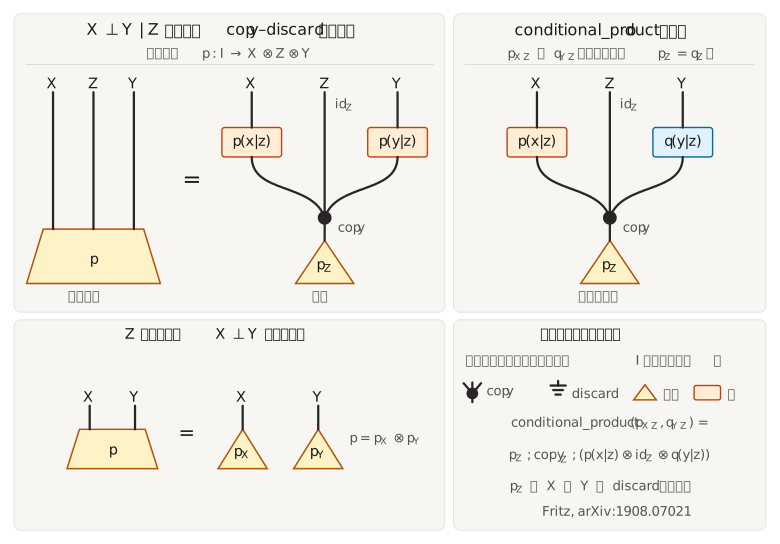
Read bottom to top: the bottom of each panel is the domain and the top
is the codomain. The joint wires are ordered X ⊗ Z ⊗ Y, as drawn.
Left: X ⊥ Y | Z is the copy–discard equation. Right: the
conditional_product construction
p_Z ; copy_Z ; (p(x|z) ⊗ id_Z ⊗ q(y|z)). Bottom: when Z is
trivial, conditional independence is the product of the marginals.
The API lays the same variables out as X ⊗ Y ⊗ Z (Z last), so a
tensor returned by conditional_product is ordered X ⊗ Y ⊗ Z.
Conditional product
conditional_product() takes joints
p_{XZ}: I → X ⊗ Z and q_{YZ}: I → Y ⊗ Z (or kernels that share a
domain) and returns the joint on X ⊗ Y ⊗ Z that is conditionally
independent given Z and has those marginals. on is the 1-based
index of the first Z factor in both codomains, or a pair
(on_p, on_q) when X and Y have different numbers of factors.
The Z factor sizes must match, and the two Z marginals must agree
within atol and rtol; otherwise the method raises ValueError.
An out-of-range split raises ValueError as well.
The construction is p_Z ; copy_Z ; (p(x|z) ⊗ id_Z ⊗ q(y|z)), which is
the right-hand panel of the figure (wires X ⊗ Z ⊗ Y). The method then
moves Z past Y so the returned codomain is X ⊗ Y ⊗ Z.
Forecast, weather, and umbrella
The forecast drives both the weather you meet and whether you carry an
umbrella. Given the forecast, weather and umbrella are conditionally
independent. The marginal on weather and umbrella still couples them, so
is_independent is false there.
import numpy as np
from fxtensor_salmon import FXTensor

forecast = ["Sunny", "Rainy"]
weather = ["Dry", "Wet"]
umbrella = ["Leave", "Take"]
# Joints on (weather, forecast) and (umbrella, forecast). Both forecast
# marginals are [0.5, 0.5].
p_wf = FXTensor(
    [[], [weather, forecast]],
    data=np.array(
        [
            [0.45, 0.05],  # Dry
            [0.05, 0.45],  # Wet
        ]
    ),
)
p_uf = FXTensor(
    [[], [umbrella, forecast]],
    data=np.array(
        [
            [0.40, 0.10],  # Leave
            [0.10, 0.40],  # Take
        ]
    ),
)
joint = FXTensor.conditional_product(p_wf, p_uf, 2)
assert joint.labels == (None, [weather, umbrella, forecast])
assert joint.is_conditionally_independent(2, 3)
weather_umbrella = joint.marginalization(3)
assert weather_umbrella.labels == (None, [weather, umbrella])
assert not weather_umbrella.is_independent(2)