Exchangeability
A state p: I → X^{⊗n} is exchangeable when a permutation of the factors
leaves it unchanged. Adjacent transpositions generate the symmetric group, so
it is enough to test those. p is exchangeable at position k
(1-based) when
p ; (id^{⊗(k-1)} ⊗ swap(X, X) ⊗ id^{⊗(n-k-1)}) = p.
Swapping the k-th and (k+1)-th wires leaves p unchanged. The
identity wires and the two swapped wires use (k-1) + 2 + (n-k-1) = n
factors.
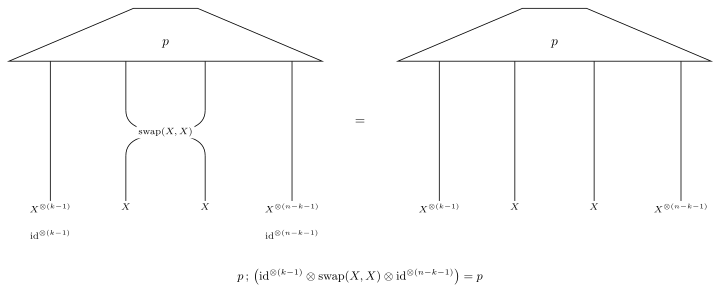
Read top to bottom. Left:
p ; (id^{⊗(k-1)} ⊗ swap(X, X) ⊗ id^{⊗(n-k-1)}).
Right: p. The crossing swaps the k-th and (k+1)-th wires.
is_exchangeable() checks k = 1 .. n-1
and compares data with numpy.allclose. swap carries no labels,
so labels are not part of the comparison. atol and rtol default to
FXTensor._ATOL and FXTensor._RTOL. n < 2 is vacuously true.
block is the dimension list of one factor X. The default, None,
takes each codomain axis as one factor, and those axes must share a size.
A codomain that mixes sizes raises ValueError. The receiver must be a
state (empty domain).
Symmetrize
symmetrize() averages the state over every
permutation of the n factors. The result has the same profile and labels
and satisfies is_exchangeable for the same block. Averaging again
changes nothing, and an already exchangeable state is left unchanged.
n > 8 warns, because the average walks through n! permutations.
Kolmogorov consistency
A sequence p_n: I → X^{⊗n} is Kolmogorov consistent when discarding the
n-th wire recovers the previous state:
p_n ; (id^{⊗(n-1)} ⊗ !) = p_{n-1}.
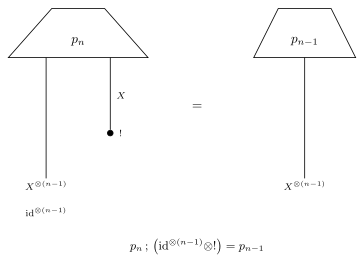
Read top to bottom. Left: p_n ; (id^{⊗(n-1)} ⊗ !). The dot is
discard on the n-th wire. Right: p_{n-1}.
is_kolmogorov_consistent() takes
[p_1, p_2, ..., p_N], so states[0] is p_1. ! is
exclamation() on X. A list of length 0
or 1 has no pair to compare; a single entry must still be a state
I → X. block is the same as for is_exchangeable. Values are
compared on data. A sequence whose marginal disagrees returns False.
A state that is not I → X^{⊗n} for its position raises ValueError.
i.i.d. and mixtures
iid() is the tensor product of n copies
of p. Labels are taken from p. For a state I → X the result is
I → X^{⊗n}.
mixture_of_iid() builds
prior ; copy_Θ^{(n)} ; kernel^{⊗n} from a state prior: I → Θ and a
kernel Θ → X. One draw from the prior is copied and then passed through
n independent copies of the kernel. The resulting state I → X^{⊗n}
is exchangeable, and the sequence in n is Kolmogorov consistent. It is
independent only when the prior is a point mass.
A prior on the bias of a coin makes the sequence of flips exchangeable. The flips are not independent, unless that prior is a Dirac mass.
import numpy as np
from fxtensor_salmon import FXTensor

bias = ["fair", "heads"]
side = ["H", "T"]
prior = FXTensor([[], [bias]], data=np.array([0.5, 0.5]))
kernel = FXTensor(
    [[bias], [side]],
    data=np.array([
        [0.5, 0.5],  # fair
        [0.9, 0.1],  # heads
    ]),
)
flips = FXTensor.mixture_of_iid(prior, kernel, 3)
assert flips.labels == (None, [side, side, side])
assert flips.is_exchangeable()
sequence = [FXTensor.mixture_of_iid(prior, kernel, n) for n in range(1, 5)]
assert FXTensor.is_kolmogorov_consistent(sequence)
# The two-flip marginal is not the product of its one-flip marginals.
pair = flips.marginalization(3)
assert not pair.is_independent(2)

point = FXTensor([[], [bias]], data=np.array([0.0, 1.0]))
fixed = FXTensor.mixture_of_iid(point, kernel, 3)
assert fixed.is_exchangeable()
assert fixed.is_independent(2)
assert fixed == FXTensor.iid(FXTensor([[], [side]], data=np.array([0.9, 0.1])), 3)
The finite form of de Finetti’s theorem in a Markov category is proved in Fritz, Gonda, and Perrone, De Finetti’s theorem in categorical probability (arXiv:2105.02639). The same two conditions — exchangeability along injections, and Kolmogorov consistency along insertions — appear as coherence of a statistical model in Vaccarino, Statistical models as natural transformations (arXiv:2609.22929).